Construction – Reverend Thomas Broad
In 1887 Rev. Thomas A. Broad began constructing a handsome, sandstone and limestone house north of Mason’s courthouse square on Comanche Creek. This project came as a request from local business men to build one of the finest two-story stone houses in town. They sold him the land for $400, giving him five years to pay them back.
Thomas Broad and his wife Grace were born in England. They immigrated to Canada and then the United States arriving in Mason about 1883. Broad was the only English speaking Methodist minister in this heavily Germanic community and traveled to different churches. He was a popular pastor whose sermons “showed deep thought and a familiarity with important scientific discoveries,” according to the Mason County News.
He became better known in Mason for his second occupation as a stone carver and builder. Broad built several houses and the two-story school house attended by his children. His work featured ornate carved limestone that contrasted with the darker sandstone. Although not completely finished, Broad sold this imposing “spec house” for $4,000 in 1889.

Reverend Broad with wife Grace.

Pictured is the home under construction. Rev. Broad is standing in doorway. His wife Grace and two of their children are barely visible in upper left window while oldest son, Ed, stands on the the roof.
.
The Reynolds Family Remodel – Edward McLaren Reynolds

E. M. Reynolds left such a big mark on Mason to have been so ephemeral. Even his place of birth is disputed. Some family members say he was born about 1864 in Wisconsin while others are insistent he was born in New York. All agree he showed up in Texas with his brother and sister and was involved in the banking business and perhaps cattle business in Bellville around 1880. He married Jennie Walker in 1888 in Huntsville. They moved to Mason where he became cashier of the newly formed Mason National Bank. He may have chosen Mason in anticipation of the railroad coming. This was one of many entrepreneurial efforts over his life time to increase his wealth.
Records are incomplete but his banking partner, E. J. Marshall, may have sold him the 2 story house constructed by Thomas Broad. Reynolds has been described as flamboyant and accustomed to finer things from his time in New York. He had grand plans for the home that included a third floor, porches, balconies, imported stain glass, indoor plumbing, and more. It is not known how he had the funds to start such a costly project as well as to purchase over twelve thousand acres and cattle in the area.
By 1896 there was no railroad coming through Mason, the economic climate was not growing and many were in trouble financially coming off a horrible drought. This and the closure of the open range forced some people to sell their land. Reynolds saw it as an opportunity to purchase land at a low price. This may have attracted the attention of the bank’s stockholders and not soon after, Reynolds found himself in quite a bit of trouble. He was charged with embezzlement of a little over $5000 as well as the unethical practices by the Comptroller of the Currency. Being the Head Cashier, he had used funds of the bank in speculation and had made the false entries to cover up the deficit.
Even though Reynolds paid everything back to depositors, in 1899 he was sentenced to five years at Leavenworth. There were many letters and petitions as well as efforts by his brother, William H. Reynolds, to get him pardoned. One court record indicated E.M had tuberculosis while in prison which was another reason to release him early.
On March 14, 1901 he was pardoned. His brother picked him up and carried a letter from E.M. Reynold’s wife, Jennie, telling him not return to Mason. He never did. A rarity at the time, Jennie received an uncontested divorce from Reynolds in which she was awarded the house and sole custody of the children on Sept. 26, 1904.
EM Reynolds went on to engage in more speculative business venture in Oklahoma and Kansas involving land and mineral rights in Indian Territories. The family has old stock certificates from Reynolds Oil and Gas listing Reynolds as president. Eventually he wound up in Deer Run, MN where he had purchased a considerable amount of property for land development. There is no indication that he ever succeeded in becoming wealthy. The eventual ownership of his land is unknown. He died on June 30, 1932 in Minnesota with no connections to his family.
Jennie Reynolds
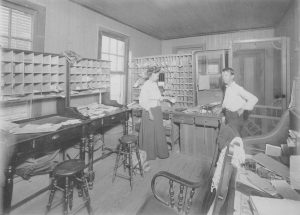 Jennie Reynolds was born Mary Virgina Walker in 1868. Her father was a Confederate general and later worked for the Big Four RR. He sent Jennie, at age six, and her sister to a boarding school after the death of their mother. She continued her education at a women’s college in Waco, then met and married EM Reynolds. Their first child, Bennellen, was born in Belton and they had three sons after moving to Mason. Having four children in five years, coming to a new community, and enduring a major house addition must have been a challenge. In 1897 when her husband was convicted of bank fraud and sent to prison she was left to take care of her family on her own. Her father may have come to live at the house and help. She also took in boarders to make ends meet.
EM Reynolds never returned to Mason and Jennie took a highly unusual step and petitioned for a divorce in 1904. She was awarded sole custody of their children and ownership of the home. In 1919 through unclear transactions, she received just $4000 for her grand home. That same year it was purchased by Oscar and Ida Seaquist for $4000. In 1916 Jennie was appointed Postmistress by President Wilson. She served for twenty-five and a half years.
Only her daughter Benellen had children. Jennie was known as “Nanny Reynolds “ and described by family and neighborhood children as sweet and kind until her death in 1952. Her life history also expresses her talents and fortitude.
Richard Grosse – Architect
 Richard Grosse was born in Germany in 1860 to a family of master builders. He became a licensed architect then immigrated to Texas at the age of 23. In the Mason area he was hired as the architect on the Lutheran Church, the elementary school, the jail, as well as churches in Art and Hilda and large ranch homes. He was a busy man marrying Lousie Caroline Donop in 1886 and then having seven children.
Grosse worked with EM Reynolds on the magnificent expansion of the Seaquist House. He designed the third floor with enhanced acoustics, as well as the porches, balcony, turret and cupola. He cleverly improved the houses ventilation with narrow screened doors. The finished product was a stunning example of Victorian Italianate architecture.
Grosse founded a lumber yard on the Mason Square. During the early days he delivered lumber on his shoulders about town. Although Grosse died in 1944, the business was still in operation in 2002. The building was later transformed into a restaurant and B&B keeping much of its original character and storage facilities.
The Seaquist Family

In 1919, the Reynolds family sold the property to Swedish immigrant Oscar Seaquist (originally Sjokvist), who had come to America in 1901 after going AWOL from the Swedish army. He arrived in Mason in 1902. Seaquist’s family had disowned him, disapproving of both of his decisions to leave Sweden and his “lowbrow” occupation as a bootmaker. Oscar, in turn, declared: “I am an American. The old ways have been forgotten.” According to family stories, he may have bought the impressive residence to prove to his relatives back home that he had prospered in Texas. The Seaquist family made several improvements to the house. They replaced the wooden porch floor and columns on the first story with concrete ones. They also finished the interior.
Oscar Seaquist died in 1933. His widow, Ada, continued to care for the mansion for four decades until her death in 1972, refusing to let anything get run down. She rented rooms during those years, and several of Mason’s older residents still have fond memories of the time they spent living in the Seaquist house.
The Seaquists’ son and daughter-in-law, Garner and Clara Seaquist, began the first major refurbishment of the house in 1972. The project was a labor of love, for the Seaquists already had their hands full ranching and operating their busy Hilltop Restaurant (now Mi Pueblo Restaurantè). Work was completed in the summer of 1973, and for the first time the mansion was opened to the public for tours. It received a Texas state historical marker in 1974 and was listed on the National Register of Historic Places. After being featured in Texas Highways in 1975, the beloved local landmark became a tourist draw for Mason and was the site of weddings, dances, book signings and gala events.
Tours of the Seaquist house were discontinued in the mid-1990s. Today this iconic mansion is being brought back to life by the Seaquist House Foundation, generous donors and volunteers.
Architecture
Labeled a Queen Anne style home by the Texas Historical Commission in the 1970s, the Seaquist house nevertheless combines a number of architectural elements and styles in its design. The home features an asymmetrical facade and is roughly L-shaped with a prominent front bay window. The original two-story structure built by Reverend Broad in 1887 was a simpler home in a more Italianate style, with a central squared tower that now forms the front entryway and foyer. The original bay of the home was rebuilt and the alcove enlarged by the Reynolds family in 1891, creating an impressive front crowned by the third floor’s Juliet balcony and cupola. The home has a porch which wraps around both the first and second floor. The concrete ionic columns on the first floor were added by the Seaquist family when they purchased the home.
The home is rusticated sandstone with limestone at the corners of the building and around many of the doors and windows. Decorative limestone carvings of natural motifs, such as blooming flowers and grape bushels, surround the front door and the doors of the second and third floors directly above. Other areas around the house feature rough sandstone contrasted with smooth stone or limestone carved in a faux-brick pattern. The eaves of the home have simple wood cornices and some corbels along the third floor rooflines. The south side of the house boasts a monumental carved chimney, a turret with stained glass, and a dormer window with a small curved roof. The south side also has a series of narrow doors on the first and second floor that provide both ventilation and a decorative element. The third floor, which was added by the Reynolds family, bears smaller decorative chimneys on the east and north side. Curved windows, dormered windows with decorative woodwork, two small balconies, and the cupola with decorative finial and weathervane adorn the third floor.